
Understanding Comparative Advantage: When a collective is greater than its individual parts
Find the people whose lives you can make better—and vice versa

So in one of my previous posts I I spoke about how we can have high subjective value to one person, but low subjective value to another.
In this post I want to talk about the economic concept of comparative advantage and how by applying this concept to our personal and professional lives we can create more personal fulfillment in our own lives while also ensuring that we maximize the value we are adding to those around us.
And I’m going to to do that through the use of another allegory.
The Curious Case of Two Farmers: The Picker and The Packager
In a small semi-rural village are two farmers. Both farmers pick up and package strawberries from their farms and sell them at the local market.

However, both have different abilities with regards to picking and packaging. The first farmer is a better at picking up strawberries and the second farmer is better at packaging them. We’ll call the first farmer, “The Picker” and the second farmer, “The Packager”.
Every day The Picker and The Packager are able to pick-up and package 10 lbs of strawberries in an 8 hour day.
However, they don’t spend the same amount of time on both the picking and the packaging. Since The Picker is better at picking up strawberries he is able to pick-up the 10 lbs of strawberries faster than the Packager can. Analogously, since The Packager is better at packaging the strawberries he is able to pack the 10 lbs of strawberries in a shorter time than The Picker is able to do so.
The table below shows how many hours each farmer spends in an 8 hour day to pick and package 10 lbs of strawberries.
Hours spent in an 8 hour day picking and packaging 10 lbs of strawberries for both farmers
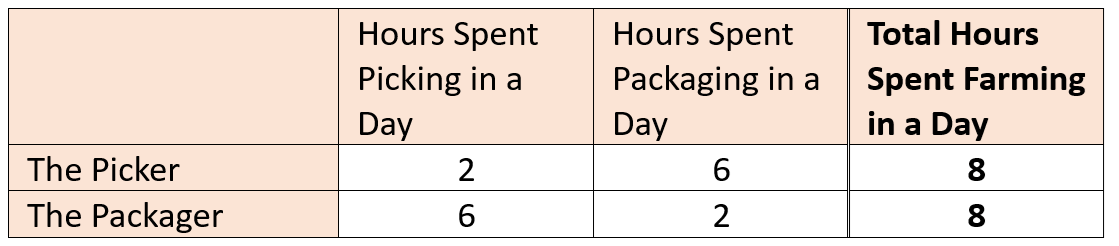
In an 8 hour day, The Picker spends 2 hours picking 10 lbs of strawberries and then 6 hours packaging those 10 lbs of strawberries.
The Packager does the opposite. In an 8 hour day, it takes The Packager 6 hours to pick 10 lbs of strawberries and then only 2 hours to package those 10 lbs of strawberries.
So both are able to pick and package 10 lbs of strawberries in a day, they just spend different amounts of time doing each activity.
After work both The Picker and The Packager play pick-up basketball at the local gym. Since it’s a local gym in their semi-rural community, most of the players at the gym work in some capacity in the farming industry (eg they’re farmers, grocers, equipment salesmen, etc).
Since they all work in the same industry and live in the same neighborhood, there is a level of familiarity and comfort amongst most of these players. They enjoy playing together and talking to each other because of it.
One day after the game, The Picker and The Packager start complaining about work. The Picker is complaining about how much time he spends packaging strawberries and The Packager is complaining about how much time he spends picking strawberries.
Suddenly both The Picker and The Packager realize that if they were to work together and have The Picker only focus on picking the strawberries while The Packager only focuses on packaging the strawberries, that collectively they would be able to pick and package more strawberries than each could do individually.
This is an innovative thought.
But also a scary one.
Both the Picker and The Packager have been working independently by themselves for decades now. They’re comfortable working by themselves. There is a routine and structure to their days that they’re used to. Working together would involve disrupting all of that. They would have to learn how to work together and change the way they think and do things in ways they’ve never had to before since they were more or less operating on autopilot.
While they are both scared to start something new, they are able to find reassurance in the fact that each of them is comfortable and trusts the other person. After all, they’re both from the same neighborhood, have lived and grown up there their entire lives, work in the same industry and both love basketball. There is a subconscious trust that would not be there if both were relative strangers to each other.
So both of them decide to work together instead of independently. The Picker spends all his time picking strawberries and The Packager spends all his time packaging strawberries.
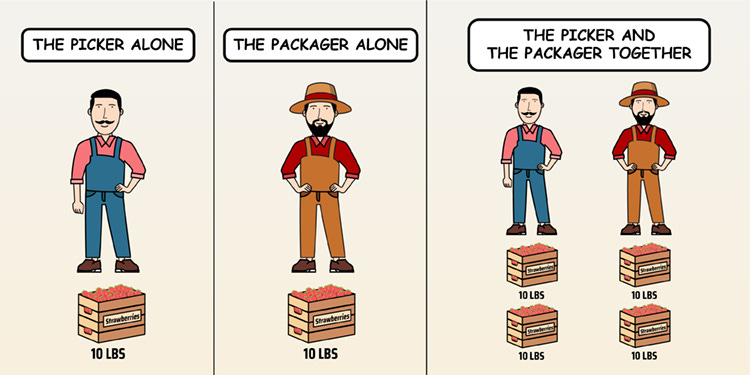
Since it only takes The Picker 2 hours to pick 10 lbs of strawberries, in an 8 hour day he is able to pick 40 lbs of strawberries—or 4 times as many as he could by himself in a day.
A similar story can be found with the Packager. In an 8 hour work day, the Packager is able to pack 40 lbs of strawberries—or 4 times as many as he could by himself in a day
By segmenting their work and working together, the Picker and the Packager are able to pick and package 40 lbs of strawberries, when working independently they could only pick and package 10 lbs each.
The Picker and the Packager split the profits from selling the strawberries. So each one is able to get the profits from selling 20 lbs of strawberries every day instead of just the 10 lbs they were able to sell in a day when they worked individually.
Both parties have doubled their profits for the day by collectively picking and packaging more strawberries by combining their talents than they would have been able to working individually.
Working Individually vs Working Together
In economics, we refer to this advantage that each party has in their area of specialty as a comparative advantage.
In other words, compared to the Packager, the Picker has a comparative advantage in picking strawberries.
Analogously, the Packager has a comparative advantage over the Picker in packaging strawberries.
By each focusing on their comparative advantage full-time, and working collaboratively as opposed to independently, both the Picker and the Packager are able to improve their productivity.
The Picker and the Packager can use this enhanced productivity to make more money (i.e. sell more strawberries in a given day) or use the time they would have spent selling the same amount of strawberries to do other activities that they love (eg spend time with their family, or play basketball).
Their quality of life has improved simply by finding someone who complements their skillset better and more closely integrating their lives together.
Creating a world that is greater than our individual parts
The reason why I wanted to highlight this concept of comparative advantage is because it neatly brings together some of the key points I’ve been bringing up with this Substack:
1) We all have an objective value to offer the world and the only way that objective value is realized is if what we have to offer is afforded the right opportunities, people, and environments to shine. So if our goal is to maximize the value we provide to those around us, we need to constantly be pursuing those opportunities, people, and environments that are right for us.
2) Even if our focus is not on enhancing the value to others, but merely to our own lives, we still must pursue these opportunities and environments. And that’s because these opportunities and environments help us find the people who help enrich our lives and make it more meaningful to us. The people who help us realize our objective potential end up holding a high subjective value in our lives because they saw something in us and invested in us when others wouldn’t.
If the Picker never finds The Packager, he never finds a partner that improves his business life.
The Picker needs The Packager in order to maximize his potential to the world.
And The Packager needs The Picker just as much.
This is how comparative advantage works.
We all have a certain value or skillset to offer other people in the world.
Not everyone can benefit from what we have to offer.
But certain people can, and we in turn can benefit from the value they have to offer.
And by meeting them, intertwining our lives and expertise with theirs, our collective lives are made better—as are those we are surrounded by.
We are made a better version of ourselves through finding the complements to our comparative advantage and combining them in ways which bring more collective value than the sum of our individual parts could.
Economic theory often deals with the optimization of human productivity and societal standards of living. There are objective metrics that deal with measuring this. Gross domestic product per capita is one such measurement, for example. But we can apply this concept to our personal lives as well.
Through collaboration, The Picker and The Packager improved each other’s lives in ways that are quantifiably measurable. And the reason they were able to do this is because they chose to invest their time, energy, and money into the right person.
They made valuable investments in each other that were fruitful.
Their collaboration enhanced their productivity in ways that could allow them to make more money and invest in others in similar ways or buy things or experiences that enhance the quality of their lives.
Or they could use that enhanced productivity to work half the hours they previously did while making the same amount of money. This gives them more time that they could use to invest in the people and activities in their life that give their life meaning.
Either way, The Picker and The Packager provided each other with money and/or time that they otherwise would never have had. And both of them now have the ability to use this time and money to improve their lives and the lives of those around them in ways that would not have been possible without the other.
What is harder to measure is the subjective assessment of personal fulfillment that comes from realizing our human potential—from the feeling that what we do matters to someone.
But it’s hard to make an investment of time and money in someone and improve the quality of his or her life and not have a high subjective value to them.
Take your life for example.
Who were the people that invested their time, money, energy, and heart into you in ways that improved the quality of your life?
Was it your parents? A teacher? A coach? A mentor? A business partner?
What is the subjective value that they hold in your life because of that?
My guess is that it’s really high.
These individuals invested exactly what you needed to help you objectively improve the quality of your life.
And because of it, you value their role in your life highly.
So as we enter into 2024, I hope you find people in your life who you can collectively invest your time, money, energy, and heart in ways that allow both of your lives to be better in ways that they couldn’t be if each of you only chose to invest in yourselves individually.
And if it’s the right fit, I think you’ll find that both of you will hold a place in the others’ life that cannot be replaced.
And this sense of meaning and mutual appreciation is probably what you were looking for all along.
Happy New Year.